Whatsapp it to +919892507784 OR e-mail it to jyotika@excellingpsychology.com
Receive G-Pay ID (India) or PayPal ID (overseas) to make the payment
Complete payment and receive the full PDF file as a reply on your WhatsApp chat/e-mail ID!!
*Prices are slightly higher for overseas learners due to commission and service charge deducted by PayPal on every purchase made. Thank you for understanding.
**You can also purchase by making a direct transfer to bank account. Just mention that you would like to receive bank account details with your message on WhatsApp/e-mail
You can preview a sample of the pdf document that you will receive upon purchase below-
PS – The above is only a sample preview. Upon purchase, you will receive a downloadable PDF of the complete Practice set with 32 pages including complete questions and the model answers to all questions.
Purchase more such material to secure your 7 in your IB Psychology exam. Visit the IB Psychology Section on Excelling Psychology below-
Whatsapp it to +919892507784 OR e-mail it to jyotika@excellingpsychology.com
Receive G-Pay ID (India) or PayPal ID (overseas) to make the payment
Complete payment and receive the full PDF file as a reply on your WhatsApp chat/e-mail ID!!
*Prices are slightly higher for overseas learners due to commission and service charge deducted by PayPal on every purchase made. Thank you for understanding.
**You can also purchase by making a direct transfer to bank account. Just mention that you would like to receive bank account details with your message on WhatsApp/e-mail
You can preview a sample of the pdf document that you will receive upon purchase below-
PS – The above is only a sample preview. Upon purchase, you will receive a downloadable PDF of the complete Practice set with 19 pages including complete questions and the model answers to all questions.
Purchase more such material to secure your 7 in your IB Psychology exam. Visit the IB Psychology Section on Excelling Psychology below-
Whatsapp it to +919892507784 OR e-mail it to jyotika@excellingpsychology.com
Receive G-Pay ID (India) or PayPal ID (overseas) to make the payment
Complete payment and receive the full PDF file as a reply on your WhatsApp chat/e-mail ID!!
*Prices are slightly higher for overseas learners due to commission and service charge deducted by PayPal on every purchase made. Thank you for understanding.
**You can also purchase by making a direct transfer to bank account. Just mention that you would like to receive bank account details with your message on WhatsApp/e-mail
You can preview a sample of the pdf document that you will receive upon purchase below-
PS – The above is only a sample preview. Upon purchase, you will receive a downloadable PDF of the complete Practice set with 22 pages including complete questions and the model answers to all questions.
Purchase more such material to secure your 7 in your IB Psychology exam. Visit the IB Psychology Section on Excelling Psychology below-
Whatsapp it to +919892507784 OR e-mail it to jyotika@excellingpsychology.com
Receive G-Pay ID (India) or PayPal ID (overseas) to make the payment
Complete payment and receive the full PDF file as a reply on your WhatsApp chat/e-mail ID!!
*Prices are slightly higher for overseas learners due to commission and service charge deducted by PayPal on every purchase made. Thank you for understanding.
**You can also purchase by making a direct transfer to bank account. Just mention that you would like to receive bank account details with your message on WhatsApp/e-mail
You can preview a sample of the pdf document that you will receive upon purchase below-
PS – The above is only a sample preview. Upon purchase, you will receive a downloadable PDF of the complete Practice set with 32 pages including complete questions and the model answers to all questions.
Purchase more such material to secure your 7 in your IB Psychology exam. Visit the IB Psychology Section on Excelling Psychology below-
Whatsapp it to +919892507784 OR e-mail it to jyotika@excellingpsychology.com
Receive G-Pay ID (India) or PayPal ID (overseas) to make the payment
Complete payment and receive the full PDF file as a reply on your WhatsApp chat/e-mail ID!!
*Prices are slightly higher for overseas learners due to commission and service charge deducted by PayPal on every purchase made. Thank you for understanding.
**You can also purchase by making a direct transfer to bank account. Just mention that you would like to receive bank account details with your message on WhatsApp/e-mail
You can preview a sample of the pdf document that you will receive upon purchase below-
PS – The above is only a sample preview. Upon purchase, you will receive a downloadable PDF of the complete Practice set with 52 pages including complete question papers, all resource booklets and model answers to all questions.
Purchase more such material to secure your 7 in your IB Psychology exam. Visit the IB Psychology Section on Excelling Psychology below-
A specimen question is presented below followed by a model answer, followed by an analysis of how the model answer meets top markband requirements. Happy learning!
The Question
Discuss the following study with reference to two or more of the following concepts: bias, causality, measurement, and/or responsibility.
To test whether self-esteem affects attraction, Kiesler and Baral conducted an experiment. They administered a fake IQ test to two groups of men and gave them fictitious scores.
One group was told that they had scored the highest scores ever seen on the test. The second group was told that there must have been some misunderstanding because their scores were so low and that the test markers could not account for the errors. The second group was asked to redo the test two weeks later.
The scores were given to each participant individually, after which the participant was asked to wait in another room to receive his payment for participating in the study. During that time, an attractive woman (who was part of the experiment) walked into the room and sat one seat away from the participant.
The researchers wanted to see if the participant’s self-esteem affected their willingness to engage in discussion with an attractive woman. They found that the men who received high test scores engaged in conversation with the woman more quickly and in more detail than the men who received low test scores.
Model Answer
The experiment conducted by Kiesler and Baral aimed to test whether a man’s level of self-esteem would influence his willingness to engage in conversation with an attractive woman. While the study presents a clear experimental design, a critical examination shows significant methodological concerns, particularly regarding bias and measurement. These issues substantially undermine the validity and generalisability of the study’s conclusions.
The study shows prominent forms of bias, primarily gender and cultural bias. The research uses only male participants and defines the social interaction solely as an encounter with an attractive female confederate. This approach assumes that attraction and social initiative are relevant only to heterosexual men, ignoring the behaviour of women and individuals with other sexual orientations. As a result, the findings cannot be applied to human behaviour in general, but only reflect the responses of a specific group under very particular conditions.
Furthermore, the study carries a strong Western cultural bias. The expectation that men with higher self-esteem will more readily initiate a conversation reflects cultural norms that value extraversion and assertiveness, which are more common in individualistic Western societies. In many other cultural contexts, such behaviour might be considered inappropriate or overly forward. Therefore, the dependent variable – willingness to engage – is not a neutral measure but is deeply influenced by the researchers’ own cultural assumptions about appropriate social behaviour.
Equally problematic are the issues surrounding the measurement of key variables in the study. First, the independent variable, self-esteem, is manipulated by giving participants false feedback on an IQ test. However, there is no verification that this manipulation actually succeeded in creating the intended psychological states of high or low self-esteem in all participants. Individual differences, such as a person’s pre-existing level of self-esteem or their scepticism about the test, likely affected how they reacted to the feedback. This means the study lacks a proper manipulation check, which compromises internal validity because it is unclear whether the independent variable was consistently and effectively altered across the two groups.
Second, the measurement of the dependent variable is subjective and lacks precision. The researchers measured “willingness to engage” by timing how quickly a participant began talking and by judging the detail of the conversation. The concept of “detail” is not objectively defined and would require interpretation by the observers, introducing the potential for subjective bias, especially since those observers were not blinded to the experimental condition. Moreover, this measurement may not be a valid indicator of either attraction or self-esteem. A participant might talk quickly and in detail for reasons unrelated to confidence or attraction, such as nervousness, politeness, or simple curiosity. Conversely, a person with high self-esteem might choose not to engage extensively. Therefore, the chosen measure has poor construct validity, as it fails to isolate the specific psychological trait the study intends to examine.
These problems of bias and measurement are not isolated; they interact and compound each other. The cultural biases inherent in the study’s design directly influence what behaviour is chosen to be measured and how it is interpreted. The act of “engagement” is thus defined through a culturally specific lens, which in turn affects the objectivity of the measurement process itself. This creates a circular problem where the researchers’ assumptions shape both the design and the outcomes.
In conclusion, while Kiesler and Baral’s study attempts to establish a causal link between self-esteem and social behaviour, its methodological flaws are substantial. The pervasive gender and cultural biases limit the relevance of its findings to a very narrow context. At the same time, serious weaknesses in measurement, including an unverified manipulation and a subjective, low-validity dependent variable, cast doubt on the reliability and internal validity of the results. Ultimately, the study highlights the importance of careful design in psychological research and serves as a reminder that clear experimental narratives must be supported by rigorous and unbiased methodological practices.
Read the stimuli following the questions below carefully. Then read the sample answers along with expert commentary given below. Happy learning!
This question has three parts: Part A, Part B, and Part C. Use the three sources provided to answer all parts of the question.
For Part B and Part C, you must cite the source that you used to answer the question. You can do this in two different ways:
Parenthetical Citation: For example: “…(Source 1).”
Embedded Citation: For example: “According to Source 1…”
Write the response to each part of the question in complete sentences. Use appropriate psychological terminology.
2. Using the sources provided, develop and justify an argument about the extent to which the limbic system governs human emotional and social behavior.
A. Propose a specific and defensible claim based in psychological science that responds to the question.
B.i. Support your claim using at least one piece of specific and relevant evidence from one of the sources.
ii. Explain how the evidence from Part B (i) supports your claim using a psychological perspective, theory, concept, or research finding learned in AP Psychology.
C.i. Support your claim using an additional piece of specific and relevant evidence from a different source than the one that was used in Part B (i).
ii. Explain how the evidence from Part C (i) supports your claim using a different psychological perspective, theory, concept, or research finding learned in AP Psychology than the one that was used in Part B (ii).
Source 1
Introduction
Adolescence is a critical neurodevelopmental period characterized by significant maturation within the limbic system, particularly the amygdala and hippocampus. These structures are central to emotional processing and fear memory, respectively. While their individual roles are well-documented, the development of the neural circuitry between them is less understood. This longitudinal study tracked the development of amygdala-hippocampus functional connectivity and its correlation with the emergence of anxiety symptoms over a four-year period in a cohort of typically developing adolescents.
Participants
The study recruited 150 participants (75 female, 75 male) at age 12 (M = 12.1 years, SD = 0.5) from a community sample. Participants were screened for any pre-existing neurological or psychiatric conditions. Retention rate over the four-year study was 92%, with 138 participants completing the final assessment at age 16.
Method
Participants underwent annual functional Magnetic Resonance Imaging (fMRI) scans while at rest (resting-state fMRI) to measure intrinsic functional connectivity. Immediately following each scan, participants completed the Generalized Anxiety Disorder 7-item (GAD-7) scale, a validated self-report measure of anxiety symptom severity. The primary analysis focused on the correlation strength (functional connectivity) between the bilateral amygdala and the bilateral hippocampus.
Results and Discussion
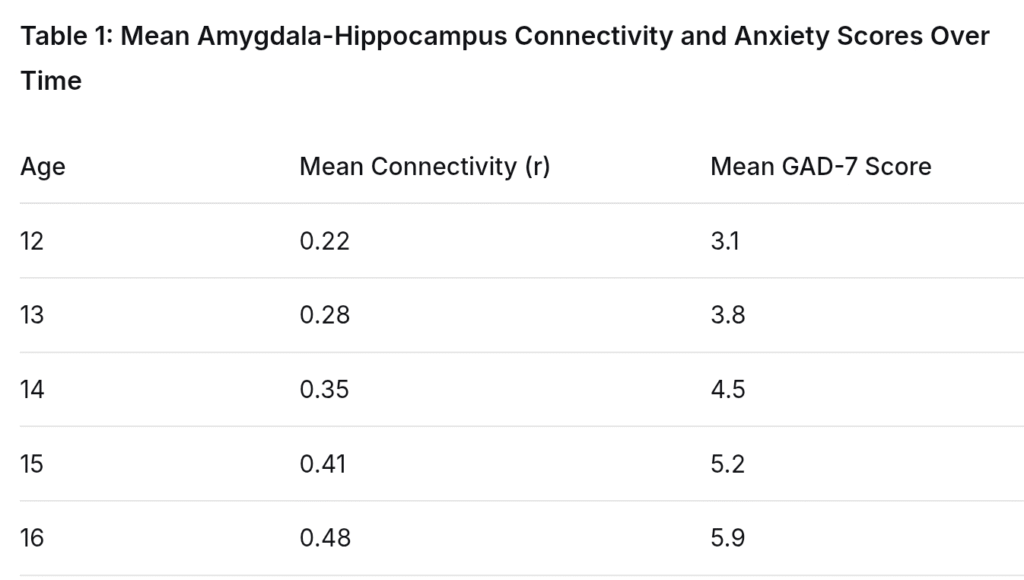
The longitudinal data revealed a clear developmental trend. Amygdala-hippocampus connectivity strengthened significantly from age 12 to 16. Crucially, individual differences in this trajectory were predictive of anxiety outcomes. Participants who showed a steeper-than-average increase in connectivity reported higher levels of anxiety symptoms by age 16. The data table below illustrates the mean connectivity strength (represented by correlation coefficient, r) and mean GAD-7 scores across the study period.
Chen, L., & Hayes, M. P. (2021). A longitudinal fMRI investigation of amygdala-hippocampus connectivity and its relationship to anxiety trajectories in adolescents. Journal of Developmental Cognitive Neuroscience, 52, 101012. https://doi.org/10.1016/j.dcn.2021.101012
Source 2
Introduction
The limbic system is crucial for social behavior. The hypothalamus, a key part of this system, produces and responds to oxytocin, a hormone linked to love and bonding. This study used prairie voles, small rodents known for forming lifelong monogamous pairs, to test if oxytocin in the hypothalamus is necessary for forming a preference for a specific partner.
Participant
The study used 80 adult female prairie voles that had no prior mating or long-term social experience (they were sexually naive). They were divided into two groups of 40.
Method
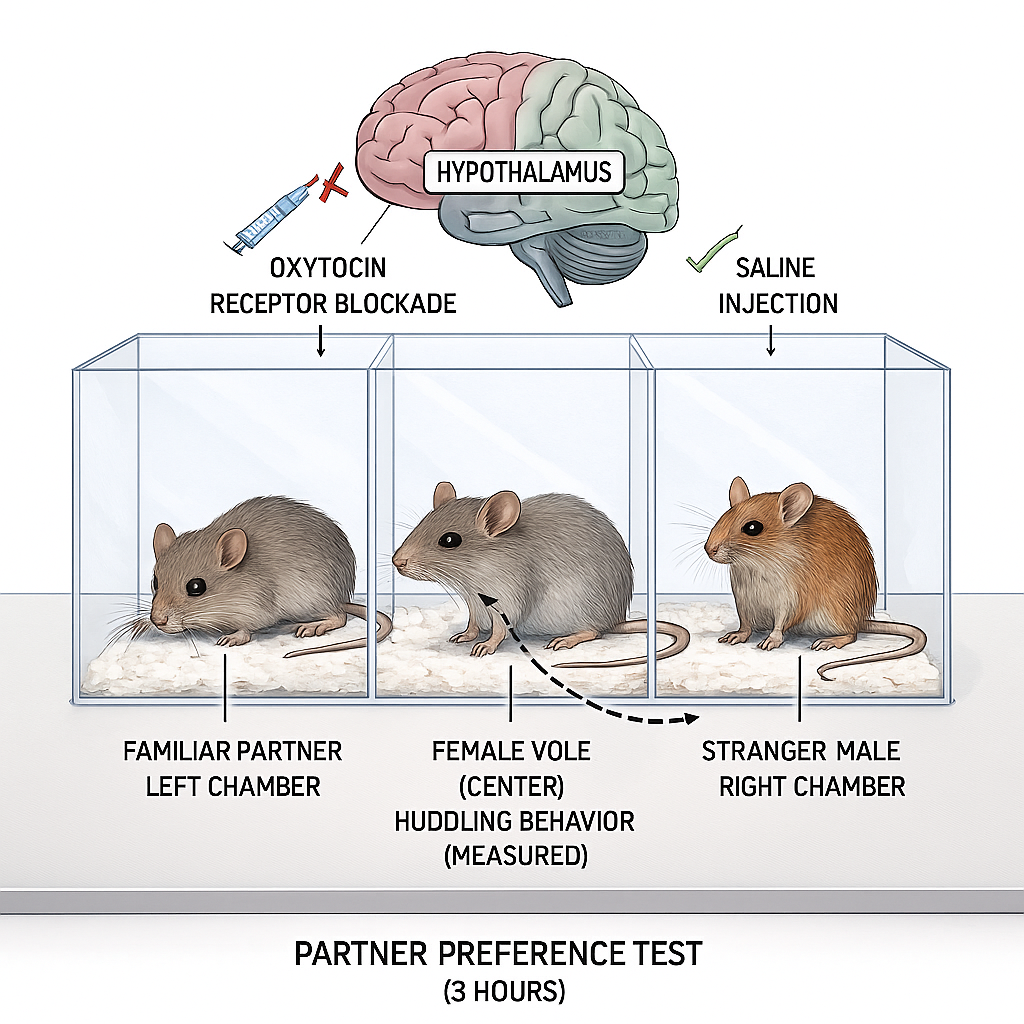
Each vole spent 24 hours with a male vole to become familiar with him. Then, the experimental group received an injection into the hypothalamus that blocked oxytocin receptors (the parts of the brain that allow oxytocin to work). The control group received a harmless saline injection in the same brain area. After recovery, each female was placed in a three-chamber cage for a 3-hour “partner preference test.” Her familiar partner was tethered in one chamber, and an unfamiliar, stranger male vole was tethered in another.
Researchers measured the percentage of time the female spent huddling side-by-side with each male, which is a sign of social bonding in voles.
Results and Discussion
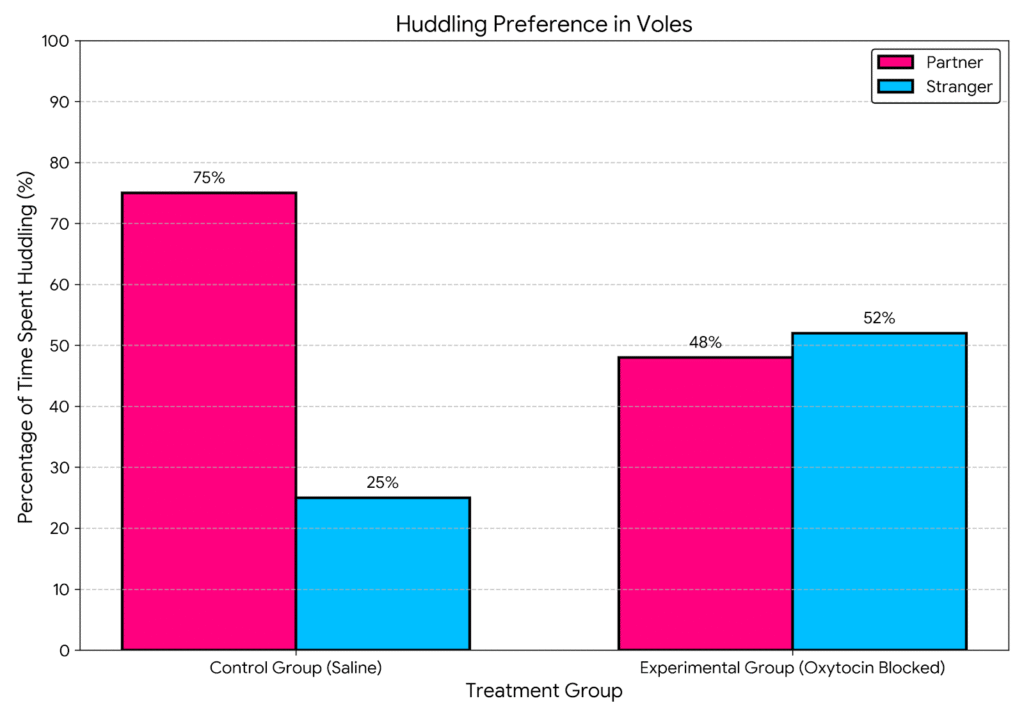
The results were clear. Voles in the control group, who received the saline injection, showed a strong preference for their partner. In contrast, the voles that had their oxytocin receptors blocked showed no preference, spending equal time with the partner and the stranger. The results can be seen in the graph below-
Rivera, S., & Feldman, R. L. (2022). The role of the hypothalamus in social bonding: A study of prairie voles. Behavioral Neuroscience, 136(3), 245-255. https://doi.org/10.1037/bne0000514
Source 3
Introduction
Sometimes, the best way to understand how a brain region works is to see what happens when it is damaged. This report from a national health institute summarizes the behavioral patterns observed in patients with injuries to different parts of the limbic system. By looking at these clinical cases, we can create a direct link between specific limbic structures and the emotions and behaviors they control.
Methodology
The report reviewed the medical files of 200 patients with confirmed damage to one of three limbic system areas: the amygdala, the hippocampus, or the cingulate gyrus. The damage was caused by strokes, tumors, or surgery. For each patient, neurologists and psychologists documented the primary changes in their behavior and emotional responses.
Results and Discussion
Amygdala Damage: Patients with amygdala damage had great difficulty recognizing fear in other people’s faces and often showed a lack of fear in situations that would normally scare most people. They also often displayed poor social judgment, trusting strangers too easily.
Hippocampus Damage: The most common problem for these patients was severe memory loss, specifically the inability to form new conscious memories (anterograde amnesia). Their old memories and intelligence often remained intact, but they could not remember new people or events for more than a few minutes.
Cingulate Gyrus Damage: Damage here often led to a profound loss of motivation and emotion. Patients became extremely apathetic, showing little interest in speaking, moving, or engaging with others, even though they were physically able to.
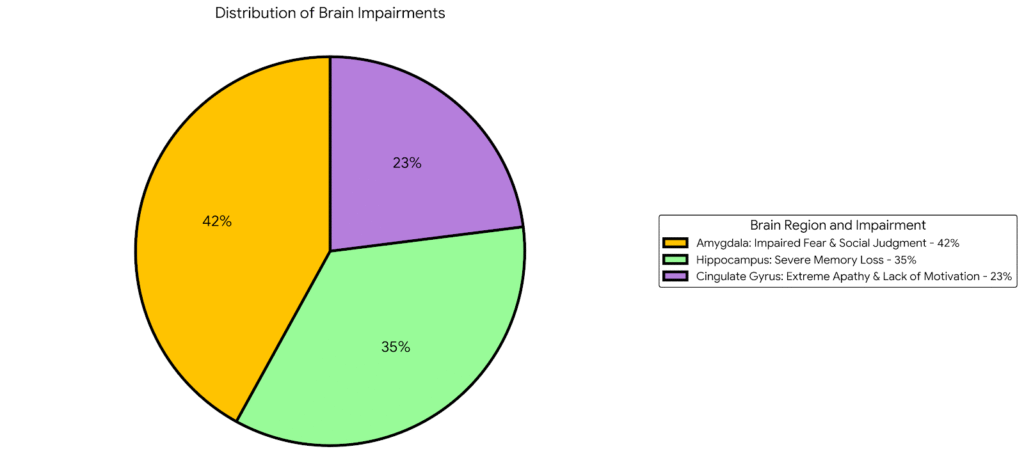
The chart below shows the breakdown of the most common type of behavioral impairment documented for patients with damage to each of the three key limbic structures.
National Institute of Neurological Disorders and Stroke (NINDS). (2023). Clinical case profiles: Behavioral changes from limbic system damage. Clinical Neurology Report, 41(2), 88-95. https://doi.org/10.1176/appi.neuro.23010034
(Note: The created source texts are fictionalized and condensed version inspired by the paradigms and findings of limbic system growth, damage and related studies in the field.)
Questions and Answers
Commentary
Part A: Propose a specific and defensible claim.
“The limbic system is the main driver of our most basic emotional and social behaviors. Structures within the limbic system, like the amygdala and hypothalamus, have specific jobs that control things like fear, memory, and social attachment, showing that this brain network is essential for how we feel and interact with others.”
This is a strong, defensible claim. It is specific (“main driver,” “basic emotional and social behaviors”), defensible (it can be supported with evidence from the sources), and rooted in psychological science (it names specific brain structures and their functions). It directly responds to the prompt’s core issue.
Part B (i): Support your claim with evidence from a source.
“In Source 2, when researchers blocked oxytocin in the hypothalamus of the voles, they didn’t show a partner preference anymore and spent equal time with a stranger (Source 2).”
This is effective evidence. The student provides a specific and relevant piece of data from the source (the result of the oxytocin blockade). The citation is correctly and clearly done.
Part B (ii): Explain with a psychological concept.
“This supports my claim because it shows the role of the limbic system in social behavior through the concept of neurotransmitters. Oxytocin is a neurotransmitter that works in the limbic system. The study proves that this specific chemical in this specific brain part is what causes the social bonding behavior. Without it, the bond doesn’t form, showing that the limbic system is in charge.”
This is a clear and accurate explanation. The student correctly identifies a key AP Psychology concept (neurotransmitters). The explanation logically connects the evidence (blocking oxytocin) to the concept and then back to the claim (showing the limbic system is “in charge”).
Part C (i): Support your claim with evidence from a different source.
“Source 3 shows that damage to different limbic structures causes specific problems. For example, 42% of the cases showed that amygdala damage led to problems with feeling fear and social judgment (Source 3).”
This successfully uses a different source (Source 3). The student provides specific evidence (the 42% statistic linked to amygdala damage) and correctly uses a parenthetical citation. This meets the requirement to use a new source.
Part C (ii): Explain with a different psychological concept.
“This supports my claim by using the idea of localization of function, which is different from neurotransmitters. Localization means that different parts of the brain have different jobs. The fact that damaging the amygdala always messes up fear, and damaging the hippocampus always messes up memory, proves that these behaviors are localized in and controlled by the limbic system.”
This is an excellent application of a second, distinct concept. The student correctly identifies localization of function and explains it in their own words. The explanation powerfully links the clinical evidence from Source 3 to the concept, showing how it proves the limbic system’s primary role. The student explicitly states it is different from the concept used in Part B.
ap psychology, ap psych, ebq, frq, latest syllabus, 2025-26, 2025, 2026, new frqs, revision, model answers, practice, stimulus, past Paper answers, limbic system, neurotransmitters, biological module, amygdala, neurotransmitters
The following AAQ is based on the topic, ‘The Nervous System,’ specifically, the sub-topic of ‘Sympathetic Nervous System and the Stress Response’ from the AP Psychology Curriculum.
Read the questions and the stimulus that follows carefully, then attempt writing answers on your own. Once you’re done, check the answer key with explanation given after the stimulus. Happy learning!
Instructions
Using the source provided, respond to all parts of the question.1. Your response to the question should be provided in six parts: A, B, C, D, E, and F. Write the response to each part of the question in complete sentences. Use appropriate psychological terminology in your response.
A. Identify the research method used in the study.
B. What is the operational definition of “motor performance” in this study?
C. Based on the data in the graph, describe the difference in heart rate between the High-Pressure and Low-Pressure groups.
D. Identify at least one ethical guideline applied by the researchers.
E. Explain the extent to which the research findings may or may not be generalizable using specific and relevant evidence from the study.
F. Explain how the finding for motor errors connects to the researchers’ original hypothesis regarding the nervous system.
Introduction
Researchers aimed to investigate how a high-pressure situation influences the autonomic nervous system and fine motor control. The prediction was that performing a skilled task under social evaluation pressure would lead to increased sympathetic nervous system activation and a higher rate of motor errors compared to performing the same task in a relaxed, private setting.
Participants
The researchers recruited 120 participants from a pool of university students and community members. All participants were pre-screened to be right-handed and have normal or corrected-to-normal vision. They were randomly assigned to one of two conditions: the High-Pressure condition or the Low-Pressure condition. The final sample consisted of individuals ranging in age from 18 to 35 years (M = 23.1, SD = 4.3). The researchers provided detailed demographic information for the final sample, which is presented in the table below.
Method
The study utilized two conditions: High-Pressure and Low-Pressure. In the High-Pressure condition, participants were told they were competing for a monetary prize and that their performance was being recorded and evaluated by a panel of experts. In the Low-Pressure condition, participants were told the study was about equipment calibration and they should simply relax and try the task alone.
Motor performance was measured by counting the number of times a participant’s hand trembled enough to break contact with a stable metal plate while guiding a small metal loop along a curving wire path (a classic steady-hand task). Physiological arousal was also assessed as the average number of heartbeats per minute (BPM) recorded by a heart rate monitor during the task.
Each participant completed a single five-minute trial of the motor task after hearing the context-specific instructions. The setting was kept at a constant temperature to prevent external factors from influencing physiological readings. All equipment was standardized and tested for calibration before each session to ensure consistency in data collection.
Results
The data obtained from the study are displayed in the graph below.
The mean heart rate for the High-Pressure group was 82 BPM, which was a full 10 BPM higher than the Low-Pressure group’s mean of 72 BPM.
Similarly, the motor error data showed a dramatic effect, with the High-Pressure group making over twice as many errors on average (18.5) as the Low-Pressure group (8.2).
Beilock, S. L., & Carr, T. H. (2001). On the fragility of skilled performance: What governs choking under pressure? Journal of Experimental Psychology: General, 130(4), 701–725. https://doi.org/10.1037/0096-3445.130.4.701
(Note: The provided citation is for a seminal real-world study on perceptual expertise. The created source text is a fictionalized and condensed version inspired by the paradigms and findings of this and related studies in the field.)
Answer Key
Answer
Explanation
A. Identify the research method used in the study.
Answer: The research method used is an experiment.
This is an experiment because the researchers manipulated the independent variable (the pressure level by giving different instructions) and randomly assigned participants to the High-Pressure or Low-Pressure conditions to see the effect on heart rate and motor errors.
B. What is the operational definition of “motor performance” in this study?
Answer: Motor performance was operationally defined as the number of times a participant’s hand trembled enough to break contact with a stable metal plate while guiding a metal loop along a wire
In this specific steady-hand task, the researchers couldn’t just measure performance vaguely. They had to define it as a countable behavior: the number of times contact with the plate was broken.
C. Based on the data in the graph, describe the difference in heart rate between the High-Pressure and Low-Pressure groups.
Answer: The heart rate of the High-Pressure group (82 BPM) was 10 BPM higher than the heart rate of the Low-Pressure group (72 BPM).
The graph’s data shows that the mean heart rate for the group told they were being evaluated by experts was significantly higher than the group told the study was just about equipment calibration.
D. Identify at least one ethical guideline applied by the researchers.
Answer: The researchers debriefed all participants after the study, explaining the true purpose and the use of deception, and gave them the option to withdraw their data.
Since the researchers used deception (e.g., telling the Low-Pressure group it was an equipment calibration study), they ethically had to explain the true hypothesis afterward in a debriefing and allow participants to remove their data.
E. Explain the extent to which the research findings may or may not be generalizable using specific and relevant evidence from the study.
Answer: The findings have low generalizability to real-world high-pressure situations because the sample was limited to right-handed 18-35 year olds and the task was an artificial laboratory activity.
The study’s participants were all right-handed and from a limited age range (18-35), so we can’t be sure if the same results would happen for left-handed people or older adults. The artificial “metal loop” task also may not reflect pressure in a real sport or speech.
F. Explain how the finding for motor errors connects to the researchers’ original hypothesis regarding the nervous system.
Answer: The hypothesis was that high pressure would increase sympathetic nervous system activation (shown by higher heart rate) and cause more motor errors. The finding that the High-Pressure group made over twice as many errors (18.5 vs. 8.2) directly supports this, associating nervous system arousal to worsened motor control.
The original hypothesis predicted that the “pressure” would trigger the nervous system, leading to more mistakes. The result—that the high-pressure group made more than double the errors—is the direct evidence that confirms this nervous system link to “choking under pressure.”
ap psychology, ap psych, aaq, frq, latest syllabus, 2025-26, 2025, 2026, new frqs, revision, model answers, practice, stimulus, past Paper answers, nervous system, sympathetic nervous system
Please note – This lesson is best viewed in desktop mode – click the three dots on your browser and tick ‘desktop mode’ if viewing on a small screen device
For the frequently asked essay question on PS04, “Discuss one model of workplace stress. [20],” here is a top scoring model answer.
Lets-
first review the model answer;
then look at the markscheme requirements; and
then learn why the answer earns perfect 20 marks with examiner commentary.
The Model Answer
Karasek’s Job Demands-Control (J D-C) model suggests workplace stress results from the interaction between job demands and control. Job demands include workload, time pressure and mental effort. Control, called decision latitude, means autonomy over tasks and work organisation. The model creates four job types from these factors-
Low-strain jobs have low demands and high control.
Passive jobs have low demands and low control.
Active jobs have high demands and high control.
High-strain jobs have high demands and low control.
This high-strain combination is predicted to be most stressful. Karasek argued it’s this specific interaction that causes stress, not just high demands alone. The model therefore provides a clear framework for understanding how workplace factors combine to create stress.
A strength of this model is the strong research support from Marmot et al.’s Whitehall II study. This longitudinal study followed 7000 civil servants over five years. It found lower-grade workers had 1.5 times more heart disease than higher grades. The key factor was low decision latitude, independent of other risks like smoking. This directly supports Karasek’s emphasis on control as crucial for stress. Therefore, this high-quality evidence validates the model’s core principle about control.
Another strength is the model’s practical usefulness for reducing workplace stress. By identifying control as key, it suggests clear interventions like increasing worker autonomy. Karasek himself showed in 1990 that enhancing job control reduced stress-related health problems. This means organisations can apply the model directly to improve working conditions. The model moves beyond theory to offer real solutions. Therefore, it has significant value for creating healthier workplaces.
A weakness is the model’s oversimplification by ignoring individual differences. It assumes all workers react similarly to high-strain conditions. However, personality factors like hardiness provide a concrete counterpoint. Hardy individuals may see high demands as challenging rather than stressful, even with low control. This shows the demand-control interaction isn’t universal. Since the model doesn’t account for such individual differences, its predictions are limited for individual cases.
Another weakness is that research fails to consistently support the predicted interaction effect. Karasek’s model specifically states stress is worst when high demands meet low control. Yet Jones and Bright note many studies find no such statistical interaction. Evidence often shows control is the main factor, with demands less important. This challenges the model’s main assumption about how these factors combine. Thus, the model may be incomplete as it focuses on an interaction not strongly supported by evidence.
Markscheme Requirements
To score full 20, the following criteria have to be met-
Knowledge of one model of workplace stress is accurate and generally well detailed.
Discussion is effective.
The answer is clear, organised and focused.
Specialist terminology is mostly used effectively
Understanding how the Answer Scores Full 20 Marks
Answer
Examiner Commentary
Karasek’s Job Demands-Control (J D-C) model suggests workplace stress results from the interaction between job demands and control. Job demands include workload, time pressure and mental effort. Control, called decision latitude, means autonomy over tasks and work organisation. The model creates four job types from these factors. Low-strain jobs have low demands and high control. Passive jobs have low demands and low control. Active jobs have high demands and high control. High-strain jobs have high demands and low control. This high-strain combination is predicted to be most stressful. Karasek argued it’s this specific interaction that causes stress, not just high demands alone. The model therefore provides a clear framework for understanding how workplace factors combine to create stress.
This AO1 section is a model answer. The knowledge is accurate and well-detailed, correctly identifying all key components: the model’s name, the two core factors (with definitions and examples), and the four resulting job types.
It accurately focuses on the main prediction about high-strain jobs and the interactive nature of the model.
The answer is organised logically and sequentially; and uses specialist terminology like “decision latitude” and the job type names effectively.
A strength is the strong research support from Marmot et al.’s Whitehall II study. This longitudinal study followed 7000 civil servants over five years. It found lower-grade workers had 1.5 times more heart disease than higher grades. The key factor was low decision latitude, independent of other risks like smoking. This directly supports Karasek’s emphasis on control as crucial for stress. Therefore, this high-quality evidence validates the model’s core principle about control.
This point shows effective discussion through strong research evidence. The student selects appropriate, high-quality evidence from the source material and uses it to directly support the model’s focus on control. The explanation clearly links the empirical findings to the model’s theoretical principles, showing how the evidence validates Karasek’s approach.
Another strength is the model’s practical usefulness for reducing workplace stress. By identifying control as key, it suggests clear interventions like increasing worker autonomy. Karasek himself showed in 1990 that enhancing job control reduced stress-related health problems. This means organisations can apply the model directly to improve working conditions. The model moves beyond theory to offer real solutions. Consequently, it has significant value for creating healthier workplaces.
This shows effective discussion of practical applications. The student demonstrates the model’s real-world value by explaining how it leads to concrete interventions. The use of Karasek’s own applied research provides solid evidence for this strength. The evaluation successfully argues that the model has significant value beyond theoretical explanation.
A weakness is the model’s oversimplification by ignoring individual differences. It assumes all workers react similarly to high-strain conditions. However, personality factors like hardiness provide a concrete counterpoint. Hardy individuals may see high demands as challenging rather than stressful, even with low control. This shows the demand-control interaction isn’t universal. Since the model doesn’t account for such variations, its predictions are limited for individual cases.
This demonstrates effective critical discussion through identification of a key limitation. The student provides a concrete counterpoint using the concept of hardiness to challenge the model’s universal predictions. The evaluation successfully argues that the model’s oversimplification limits its predictive power for individual cases of employees, showing balanced and thoughtful criticism.
Furthermore, research fails to consistently support the predicted interaction effect. Karasek’s model specifically states stress is worst when high demands meet low control. Yet Jones and Bright note many studies find no such statistical interaction. Evidence often shows control is the main factor, with demands less important. This challenges the model’s fundamental premise about how these factors combine. Thus, the model may be incomplete as it emphasizes an interaction not strongly supported by evidence.
This shows effective critical discussion by challenging the model’s main assumption. The student uses specific research evidence to question the fundamental interaction concept itself. The discussion is particularly effective because it cites contradictory evidence that suggests control alone may be the dominant factor, thereby questioning the very basis of Karasek’s interactive approach.
search terms – oxford ial psychology, oxford a levels psychology, oxford aqa a level psychology, oxford aqa a levels psychology, oxford a level psychology, 9685, international a level psychology, international psychology, revision, past paper solution, karasek model of workplace stress, stress, a2, application to workplace, psychology applied to work, year 13, year 2, unit 4, ao1, ao3, description, evaluation, 20-marker, essay, paper 1, ps04, pso4
Please note – This lesson is best viewed in desktop mode – click the three dots on your browser and tick ‘desktop mode’ if viewing on a small screen device
AO1 (Description)
Researchers
Atkinson and Shiffrin (1968) proposed the multistore model of memory (MSM).
Definition of MSM
The model proposes memory as a stage-wise system comprising three unitary, structurally distinct stores: 1. sensory register (SR), 2. short-term memory (STM) and 3. long term memory (LTM);
with information transferred between them via the controlled processes of
1. attention (from SR->STM), 2. maintenance/elaborative rehearsal (to maintain in STM/transfer to LTM), and 3. retrieval (from LTM->STM).
SR Capacity
The sensory registers or modalities (eyes, ears, nose, tongue and skin) have a very high capacity.
Sperling (1960) demonstrated this using a partial report technique; participants could recall most letters from a cued row, indicating the entire iconic store was initially available but decayed rapidly.
SR Duration
Duration is extremely brief.
Sperling (1960) found iconic memory lasts ~0.5 seconds, while Darwin et al. (1972), using a similar auditory method, found echoic memory lasts up to 3 seconds before decay.
SR Coding
Coding is modality-specific, maintaining information in its original sensory form (e.g., iconic for visual, echoic for auditory, haptic for touch).
STM Capacity
Capacity is limited.
Jacobs (1887) used a digit span technique to establish a capacity of 5-9 items. Miller (1956) refined this, proposing a capacity of 7±2 chunks of information.
STM Duration
Duration is short without rehearsal.
Peterson & Peterson (1959) prevented rehearsal of trigrams with a counting task; recall fell to <10% after 18 seconds, demonstrating rapid STM decay.
STM Coding
Coding is predominantly acoustic.
Conrad (1964) showed participants visually presented consonants; recall errors were based on sound (e.g., confusing ‘V’ for ‘D’), proving information was encoded acoustically in STM.
LTM Capacity
LTM capacity is considered essentially unlimited, with no known upper bound on the amount of information that can be stored permanently.
LTM Duration
Duration can be permanent.
Bahrick et al. (1975) tested graduates’ memory for classmates; participants showed ~80% recognition accuracy after 48 years, demonstrating very long-term duration.
LTM Coding
Coding is primarily semantic.
Baddeley (1966) presented word lists; after 20 minutes, recall was worse for semantically similar words, indicating LTM uses a meaning-based code.
AO3 (Evaluation)
Case Study Support
Point: One strength is supporting evidence from neuropsychological case studies of patients with brain damage.
Evidence: For example, patient KF (Shallice & Warrington, 1970) had poor STM capacity but intact LTM, while patient HM (Scoville & Milner, 1957) could not form new LTMs but had a normal STM span.
Explanation: This dissociation suggests that STM and LTM are physically separate stores, as damage to one store impairs its function while leaving the other store unaffected, which is a core claim of the MSM.
Link: This increases the validity of the model, as it shows the proposed memory stores have a biological basis in the brain.
Brain Scan Evidence
Point: A further strength is the support from modern brain-scanning techniques.
Evidence: Squire et al. (1993) used PET scans and found that the hippocampus was active during LTM tasks, while the prefrontal cortex was active during STM tasks.
Explanation: This provides physical, objective evidence that different brain regions are responsible for short-term and long-term storage, strongly supporting the MSM’s view of separate stores.
Counterpoint: However, these scans also show that many brain areas are active simultaneously during memory tasks, which contradicts the MSM’s simple, linear view and instead supports more complex models like the Working Memory Model (WMM).
Link: Therefore, while this evidence supports the idea of separate stores, it also challenges the model’s validity by suggesting the process is more interactive than the MSM proposes.
Challenge from WMM Model
Point: A major weakness is the challenge posed by the WMM from Baddeley and Hitch (1974).
Evidence: The WMM replaced the unitary STM store with a multi-component system (e.g., central executive, phonological loop) that is active and processes different types of information simultaneously.
Explanation: Research for the WMM shows that people can perform two visual or two verbal tasks at the same time poorly, but one visual and one verbal task well. This contradicts the MSM, which sees STM as a single, passive store that would be overwhelmed by any dual-task, regardless of the type.
Link: This significantly challenges the validity of the MSM’s conceptualisation of STM, suggesting it is an inaccurate and oversimplified explanation.
Challenge from Flashbulb Memory Phenomenon
Point: One weakness is the existence of flashbulb memories, which the MSM cannot easily explain.
Evidence: Flashbulb memories are highly detailed and vivid ‘snapshots’ of emotionally significant events (e.g., where you were during a major news event) that seem to bypass the need for prolonged rehearsal to enter LTM.
Explanation: According to the MSM, transferring information to LTM requires sustained rehearsal in STM. Flashbulb memories, however, are formed instantly due to high emotional arousal, suggesting there are alternative routes to LTM that the model does not account for.
Link: This reduces the validity of the MSM, as it shows the model is an oversimplification and cannot explain all memory phenomena.
search terms – oxford ial psychology, oxford a levels psychology, oxford aqa a level psychology, oxford aqa a levels psychology, oxford a level psychology, 9685, international a level psychology, international psychology, revision, past paper solution, multistore model of memory, msm, atkinson and shiffrin, ao1, ao3, description, evaluation, 20-marker, essay, paper 1, ps01, pso1